
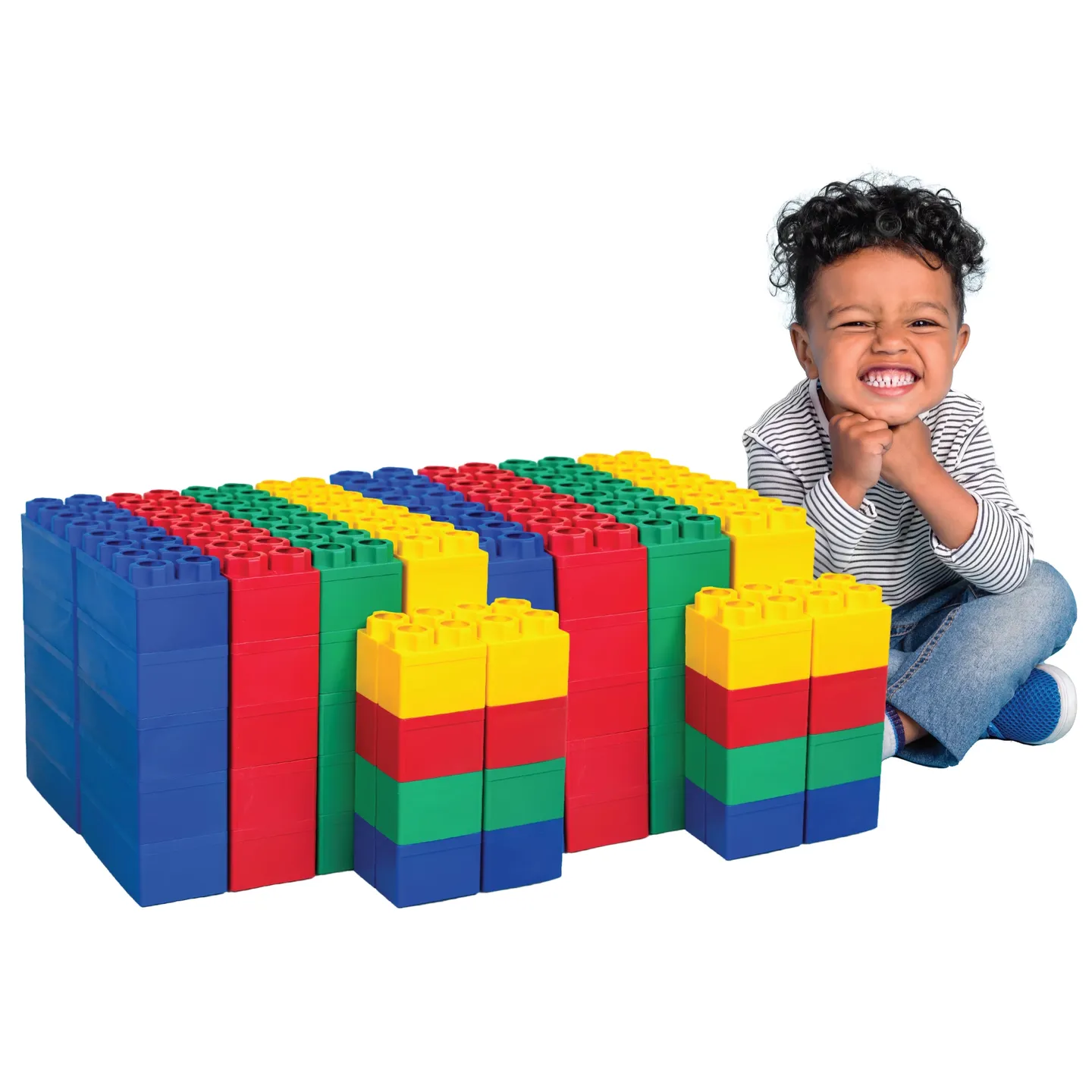
Giant Building Blocks are an excellent way to keep children entertained when rainy weather makes outdoor activities difficult. Giant Building Blocks give children an opportunity to build, imagine, experiment, and stay active indoors. With Giant Building Blocks, a living room, playroom, classroom, or childcare area can become a creative construction space filled with towers, forts, castles, bridges, and imaginative adventures. Giant Building Blocks also combine hands-on learning with open-ended play, making them a practical choice for families looking for engaging activities when children need something exciting to do inside.
Why Rainy Days Are Perfect for Creative Building
Rainy days can sometimes leave children feeling bored when they cannot play outside. Instead of relying entirely on screens or passive entertainment, parents can introduce activities that encourage movement and imagination.
Construction play provides an excellent indoor alternative because children can stay busy while creating something of their own. A simple collection of large blocks can become an entire imaginary world.
Turning Indoor Time Into Adventure
A rainy afternoon can become a building challenge. Children can create a castle and pretend to defend it from imaginary creatures, construct a spaceship for an intergalactic journey, or build a cozy fort for storytelling.
Giant Building Blocks are especially useful because they allow children to make structures that are large enough to interact with directly. The building process can become part of the adventure rather than simply preparing for it.
Reducing Rainy-Day Boredom
Having a selection of open-ended toys available can make unexpected rainy days easier for parents. Children can choose what they want to build and change the activity whenever inspiration strikes.
Because construction has no single correct outcome, children can return to the same materials repeatedly without necessarily repeating the same activity. For more information about large building blocks for kids, explore their features, benefits, age suitability, and role in encouraging imaginative and educational play.
Benefits of Giant Building Blocks for Children
Large construction activities offer more than entertainment. They can support physical, cognitive, social, and creative development.
Supporting Motor Skills
Children use their hands and bodies when they carry, stack, position, and rearrange large construction pieces. These actions encourage coordination and body awareness.
Indoor building also gives children a reason to move around rather than remaining seated for long periods.
Encouraging Problem-Solving
Construction naturally involves challenges. A tower may fall, a bridge may become unstable, or a planned structure may not fit together as expected.
Giant Building Blocks give children the opportunity to experiment with different solutions. They can rebuild, adjust their designs, and discover how placement affects stability.
Developing Spatial Awareness
Building helps children understand relationships between objects. They learn about height, width, position, distance, balance, and shape through hands-on experiences.
These concepts can support early mathematical and engineering thinking while children remain focused on creative play.
Rainy-Day Building Activities
Parents can introduce different themes to keep indoor construction interesting throughout the day.
Build a Rainy-Day Castle
Invite children to build a castle complete with towers, walls, gates, and rooms. The castle can become the center of an imaginary story.
Children can pretend to be explorers, royal characters, friendly dragons, or castle builders. Once the story changes, they can modify the structure to match their new ideas.
Create an Indoor Fort
A fort can become a comfortable indoor adventure space. Children can build walls and entrances and then use the area for storytelling, pretend camping, reading, or imaginative games.
Giant Building Blocks make it possible to create the basic structure while leaving children free to decide how their fort should look.
Build a Pretend City
Children can create houses, stores, schools, parks, bridges, and roads to form a miniature city.
This project can involve several family members. Each person can contribute a different structure, and the finished city can become the setting for imaginative role-play.
Giant Building Blocks and Creative Learning
Construction activities can support learning without feeling like formal schoolwork. Parents can introduce simple challenges involving counting, sorting, shapes, measurement, and storytelling.
Counting and Sorting Games
Ask children to count the number of blocks used in a tower or sort pieces by size, shape, or color.
These activities can reinforce early mathematical skills while allowing children to remain physically involved in their construction project.
Simple Science Experiments
Children can explore balance and stability by creating structures with different foundations. Ask them to predict which design will stand the longest.
Giant Building Blocks make these experiments hands-on. Children can immediately observe what happens when they change the structure.
Storytelling Activities
Once a structure is complete, ask children to create a story about it. A bridge could connect two imaginary kingdoms, while a tower could become a lookout station.
This encourages language development, descriptive vocabulary, sequencing, and creative expression.
Creative Play With Family and Siblings
Rainy days can provide valuable opportunities for families to play together. Construction projects can become shared activities rather than something children do alone.
Parent-Child Building
Parents can participate by asking questions and helping children explore possibilities. Instead of designing the structure themselves, adults can allow children to make the important decisions.
Questions such as “What should we build next?” or “How can we make this tower stronger?” can encourage deeper thinking.
Sibling Collaboration
Siblings can work together on a large project. One child might build a house while another creates a bridge connecting it to a tower.
Giant Building Blocks encourage cooperation because larger projects often benefit from multiple builders working together.
Creating a Rainy-Day Construction Zone
A designated building area can make indoor construction easier to manage. Choose a clear section of the room where children have enough space to build and move around.
Organizing Materials
Use baskets, shelves, or storage containers to keep construction pieces organized. If the collection contains different shapes, children can sort them by type or size.
Giant Building Blocks can be stored in an accessible location so children can begin creative projects with minimal assistance.
Keeping the Space Flexible
The building area does not need to remain a construction zone permanently. Once playtime ends, structures can be dismantled and pieces stored away.
This allows the same room to serve multiple purposes throughout the day.
Keeping Rainy-Day Play Fresh
Children are more likely to remain interested when activities change regularly. Parents can introduce a new theme each rainy day.
One day might involve building a jungle habitat, while another focuses on creating a futuristic city. A third activity could challenge children to construct the tallest stable tower.
Giant Building Blocks can support all these themes because the same pieces can be used in many different ways.
Adults can also introduce storytelling prompts. Ask children what would happen if their castle were suddenly visited by an astronaut or what their imaginary city would look like during a festival.
Safety Tips for Indoor Building
Safety should remain a priority during active construction. Choose products suitable for the child's age and follow the manufacturer's recommendations.
Children should have sufficient space to move around their structures. Keep building areas away from stairs, sharp furniture, fragile objects, and other hazards.
Teach children not to throw blocks at other people. Tall structures should be created in appropriate locations and under suitable supervision.
Inspect building pieces regularly for cracks, sharp edges, tears, or other damage and remove damaged items from use.
Frequently Asked Questions
1. Are Giant Building Blocks good for rainy-day activities?
Yes. Giant Building Blocks can provide an engaging indoor activity when children cannot play outside. They encourage construction, imagination, movement, storytelling, and problem-solving.
2. What can children build on a rainy day?
Children can create castles, forts, towers, houses, bridges, cities, animal habitats, spaceships, and many other imaginative structures.
3. Can building blocks support educational play?
Yes. Construction can introduce counting, sorting, shapes, measurement, spatial awareness, balance, stability, and basic engineering concepts.
4. Can siblings play with Giant Building Blocks together?
Yes. Collaborative construction can encourage children to share materials, communicate ideas, divide responsibilities, and work toward a common project.
5. How can parents prevent rainy-day building from becoming repetitive?
Introduce different themes and challenges. Children can build a castle one day, a city the next, and a space station later. Storytelling and creative prompts can also add variety.
Conclusion
Giant Building Blocks can turn a rainy day from a source of boredom into an opportunity for creativity, movement, learning, and family fun. Children can construct castles, forts, cities, towers, bridges, and imaginative worlds while practicing problem-solving, spatial awareness, coordination, communication, and persistence. Giant Building Blocks are particularly valuable because they can be reused for countless activities, meaning children can discover new possibilities each time they play. With a suitable indoor space, organized storage, creative challenges, and appropriate safety practices, Giant Building Blocks can become a reliable rainy-day activity for homes, classrooms, and childcare environments. Instead of simply waiting for the weather to improve, children can use rainy afternoons to build new worlds, explore imaginative stories, and turn ordinary indoor time into an exciting creative adventure.