A humanoid robot needs power for its motors, sensors, computers, and safety systems. The battery has to carry that load without making the robot too heavy to walk, lift, or recover from a stumble.
The basic problem is a trade-off: more battery adds runtime, but also adds mass that the motors must move.
- Battery mass affects walking, lifting, and balance.
- Fast charging creates heat and can add wear.
- Long work shifts need more than a large battery alone.
Why humanoid robots use so much power
A humanoid robot spends energy on every part of movement. Its actuators, the motors and gear systems that move its joints, must repeatedly lift the legs, arms, torso, and battery pack itself.
Walking also requires constant balance corrections, even when the robot appears to stand still.
The robot’s sensors and onboard computers draw power between steps. Cameras, depth sensors, joint position sensors, and control software all work together to keep the body upright and place the hands correctly. A machine carrying a box has to spend power on the box, its own body, and the corrections needed to stay stable.
That load changes the battery decision. A pack sized for a long shift may reduce the robot’s movement speed or payload. A lighter pack may keep the robot easier to control, but it can force more charging stops.
Energy density sets the limit
Energy density describes how much stored energy a battery holds for its weight. Higher energy density can give a robot more runtime without adding as much mass, but battery chemistry still has limits tied to heat, safety, cost, and cycle life.
Power density is a different concern. During a lift, a robot may need a short burst of high power when it raises a heavy object, climbs a ramp, or catches itself after losing balance. A pack can hold plenty of energy and still struggle to send that power quickly.
The battery also needs a management system. That system checks cell voltage, temperature, and charge levels, then limits the pack when conditions become unsafe. Cooling hardware adds more weight, and the robot has to carry that hardware during every task.
Battery runtime depends on the load, walking speed, and task, so a figure from an empty-room demo won't predict a work shift. Reports from Robot24.com's battery robotics coverage can tie that number to the robot, pack size, carried weight, and test conditions. That comparison matters before treating runtime as shift capacity.
Runtime is only one part of the work shift
A battery rating does not tell you how long a humanoid robot can work. Walking on a flat floor, standing in place, lifting objects, and using a tool create different power loads. One that lasts through a controlled demonstration may need more energy during repeated lifting or movement across a site.
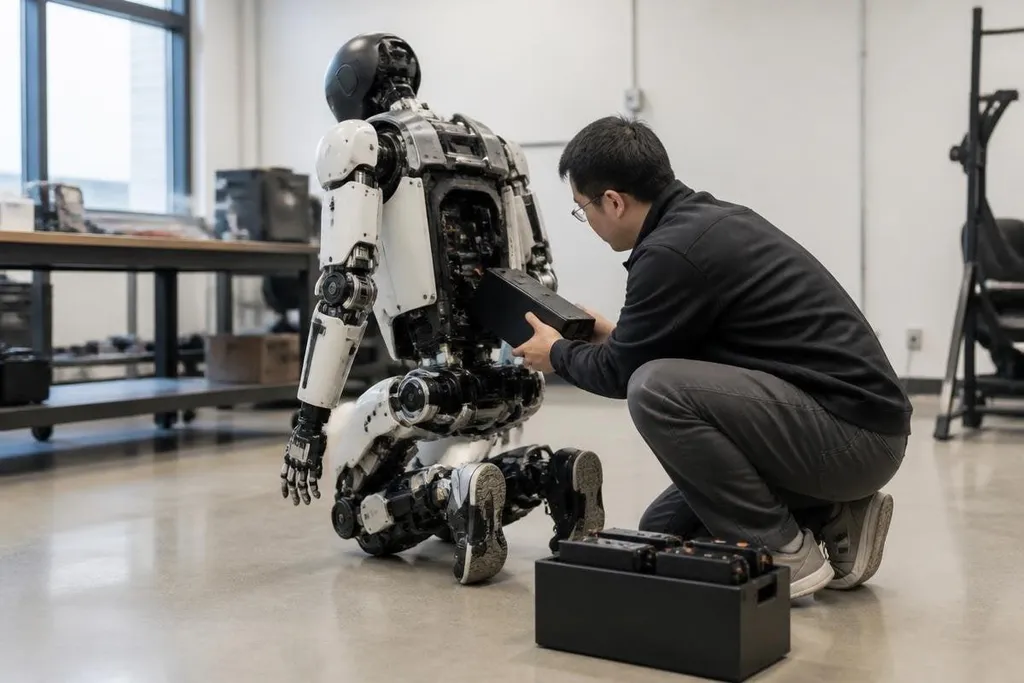
Charging time matters too. A robot that needs a long stop between tasks may require spare battery packs, a charging station, or another robot to keep work going. Swapping packs can reduce downtime, but the process adds hardware, safety checks, and staff time.
Heat can narrow the usable window. High current raises battery temperature, and hot cells may need a lower charge or discharge rate. Work near ovens, outdoors in summer, or inside a poorly cooled building creates a harder battery problem than work in a cool lab.
I’d judge a humanoid robot by its full work cycle, not its battery size. That means measuring task time, charge time, payload, movement speed, and the number of stops needed during a normal shift.
What battery progress must solve
A better battery would help, but it would not fix every limit. Humanoid robots also need efficient motors, low-loss gearboxes, lighter frames, control software that avoids wasteful movement, and charging systems that fit the workplace.
Battery improvements may arrive through new cell designs, better cooling, or packs that can be changed quickly. Each option brings a trade-off. A new chemistry may hold more energy but cost more, take longer to ship, or lack enough operating history for a busy factory.
The machine’s work matters as much as the cell. A robot that carries small parts over short distances needs a different pack from one that lifts boxes for hours. Buyers should ask for measured task data rather than treating a single runtime figure as a shift plan.
A battery check before you buy
Use these questions when comparing a humanoid robot for work:
- Task load: What does the robot carry, and how often does it move?
- Work cycle: How much time does it spend walking, standing, lifting, and waiting?
- Charge method: Does it charge in place, or can a trained worker change the pack?
- Heat control: Where are the temperature sensors and cooling parts located?
- Pack life: How many charge cycles can the maker support before capacity falls?
- Site fit: Can your floor space, power supply, and safety process support charging?
A useful battery plan starts with the job, then works backward to the pack. Until makers publish full task cycles with charge stops, heat limits, and payload data, the open question is whether a humanoid robot can complete useful work before its battery becomes the job’s main limit.